
DeKalb County Docket Basics
A docket is the court's running list of case events. In DeKalb County, a state trial-court docket may appear as a case action summary through Alabama's court-access systems. It can show when a complaint, charge, motion, notice, order, judgment, plea, hearing, sentence, or disposition was entered. A docket is not always the full file. The full file may contain pleadings, images, exhibits, certified copies, subpoenas, and other documents that require payment, a clerk request, or restricted access review.
Circuit Court and District Court dockets are routed through the DeKalb Circuit Clerk and Alacourt systems. Probate index records route through the DeKalb Probate Judge's application. Fort Payne municipal citations and city ordinance matters route through Fort Payne Municipal Court. Federal criminal, civil, bankruptcy, and appellate dockets are separate and are not held by the DeKalb Circuit Clerk.
| Docket | Full Case Record | |
|---|---|---|
| Format | Event list or case action summary | Documents, images, orders, pleadings, and certified copies |
| Main Use | Track status, dates, and outcomes | Read the legal file or prove a disposition |
| Access | Often searched online through court systems | May require fee, clerk request, or in-person review |
Find DeKalb Dockets Online
The main state trial-court channel is Alacourt's DeKalb docket search entry point. Alacourt ACCESS and Just One Look are described by official sources as public access to Alabama trial-court records, including civil, domestic, criminal, and traffic categories. Just One Look is case-by-case and paid, while AlaCourt subscription access serves account users. The DeKalb Circuit Clerk's page points the public to Just One Look for most trial-court information.
Use the DeKalb Circuit Clerk's records-request form when the online docket is not enough. Older records, archived or microfilmed records, paper-record examination, certified copies, and searches needing staff help route through the clerk's form. The form tells requesters to include the specific information wanted, case numbers if known, identifying information such as date of birth or alias, certification choice, requester contact information, a self-addressed stamped envelope, and payment.
- Open the DeKalb Alacourt docket search or the appropriate Just One Look access route.
- Select DeKalb County or use the DeKalb location-specific docket entry point.
- Search by case number when available, or use a party name and case category.
- Read the case action summary entries for event dates, filings, orders, hearings, and disposition.
- Request copies from the Circuit Clerk if the docket does not provide the image or certified document needed.
The first assigned docket image comes from Alacourt's terms and document pricing page.
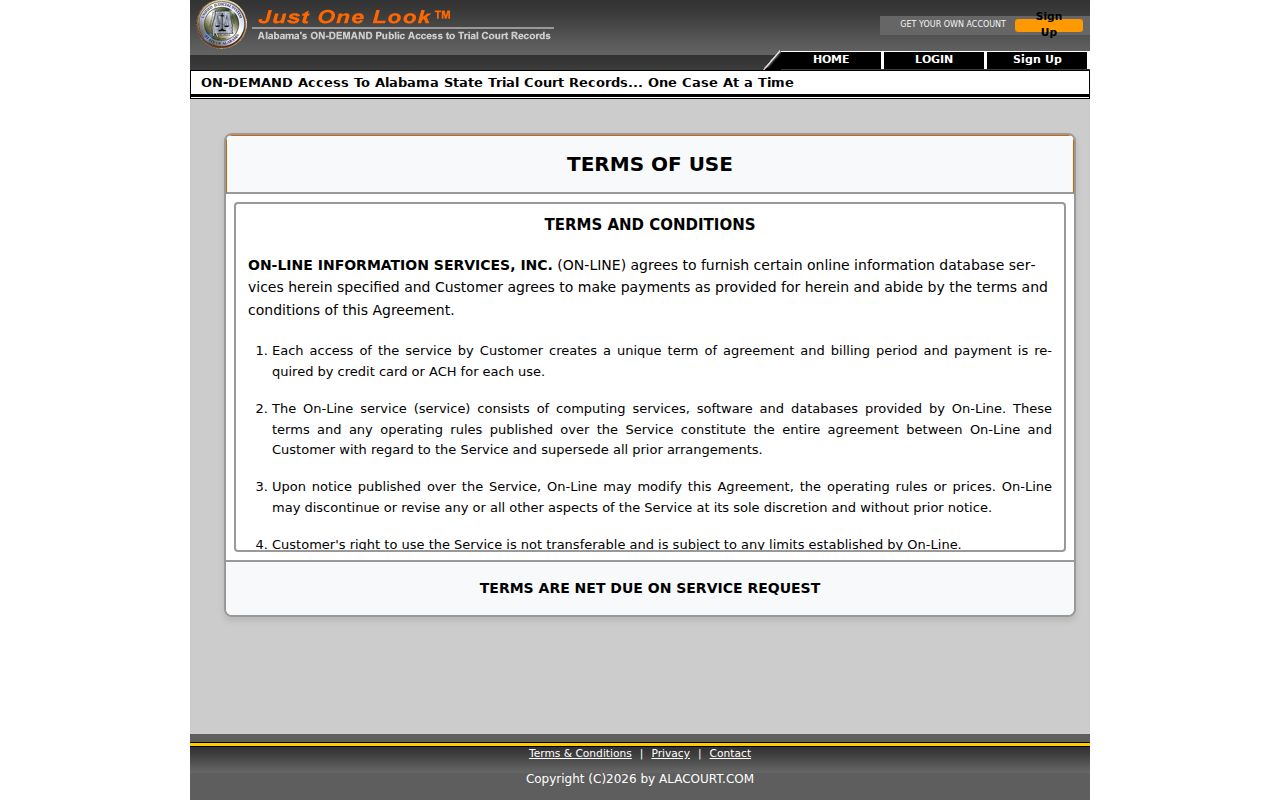
Those terms matter because a docket view and a document image can be priced and accessed differently in Alabama's court systems.
DeKalb Docket Entry Fields
The research file did not identify a public sample DeKalb state docket record, but it did identify common fields found in DeKalb County court records and Alacourt case-action-summary material. Docket entries should be read as event records. They do not replace a certified disposition or a full file review by the Circuit Clerk.
| Field | What It Shows |
|---|---|
| Entry Date | The date a filing, order, notice, hearing, judgment, plea, sentence, or other event was entered. |
| Event Type | The court action, such as motion, order, hearing, subpoena, disposition, appeal, or clerk notice. |
| Party or Division | The party, clerk division, court, or case category connected to the event when shown. |
| Document Image | Indicates whether an image may be available through paid access or a clerk request. |
| Disposition | The outcome or current status, which may need certified confirmation for official use. |
The Alabama traffic-resolution channel is assigned as a docket image from Resolve.alacourt.gov.
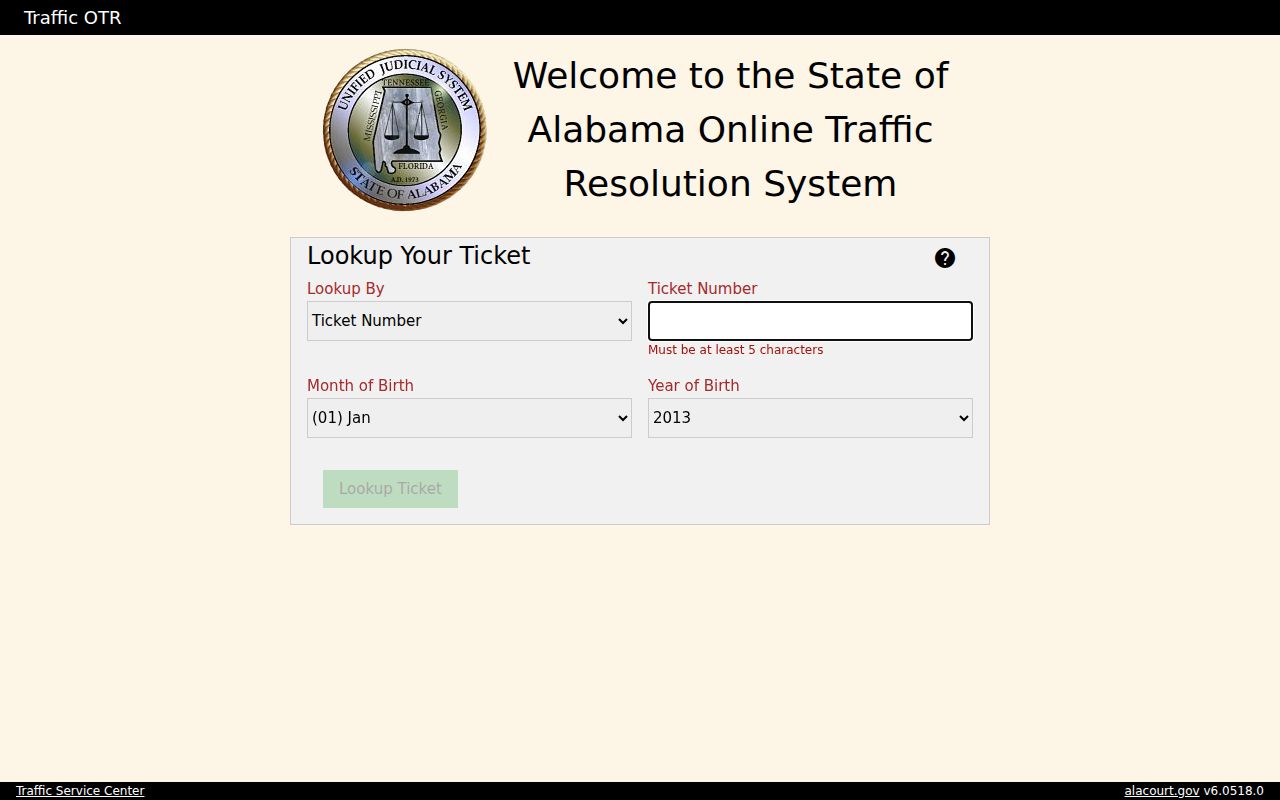
Traffic resolution is included because DeKalb traffic citations can produce court events, payment deadlines, trial settings, and failure-to-appear consequences.
DeKalb Courts With Dockets
DeKalb County is part of Alabama's 9th Judicial Circuit. Circuit Court is the highest trial court in the county and is the primary trial court page for this project. District Court remains a separate lower-court category because DeKalb has official District Court material for civil, criminal, small claims, evictions, traffic, and preliminary felony proceedings. Probate Court and Municipal Court have distinct records and should not be merged with Circuit Clerk dockets.
- Circuit Court dockets cover felony, higher-dollar civil, domestic relations, appeals from lower courts, and jury-trial matters.
- District Court dockets cover misdemeanors, preliminary felony proceedings, traffic citations, small claims, evictions, and lower-dollar civil actions.
- Probate Court records use the Probate Records Application for probate and recording indexes rather than Alacourt state trial-court docket search.
- Fort Payne Municipal Court handles city traffic citations, municipal ordinance violations, parking violations, and misdemeanor arrests initiated by Fort Payne Police.
Probate docket and index material is represented by the DeKalb Probate Records app.
The probate app's separate search model is a reminder that probate and recording records do not use the same docket path as Circuit Court and District Court cases.
Probate and Municipal Dockets
The DeKalb Probate Records Application supports name, case, book/page, instrument, date, UCC, subdivision, index, marriage-index, and probate-index searches. It can show recording and probate index material that is outside the Circuit Clerk's state trial-court scope. The app also displays search messages when criteria are missing or when a date-only search exceeds the allowed span configured in the system.
Fort Payne Municipal Court is a separate city court. It handles Fort Payne Police traffic citations, municipal ordinance violations, parking violations, and misdemeanor criminal arrests. The city court is held in the City Hall courtroom on Mondays at 4 p.m. The official Fort Payne online payment channel uses citation or case number search and is not a general DeKalb County court docket database.
The Probate Records search interface appears in the manifest through the official search application view.
That search interface is useful for probate and recorded-record research, but it should not be used as proof that no Circuit Court or District Court case exists.
The municipal ticket payment image comes from the Fort Payne citation and case-number search.
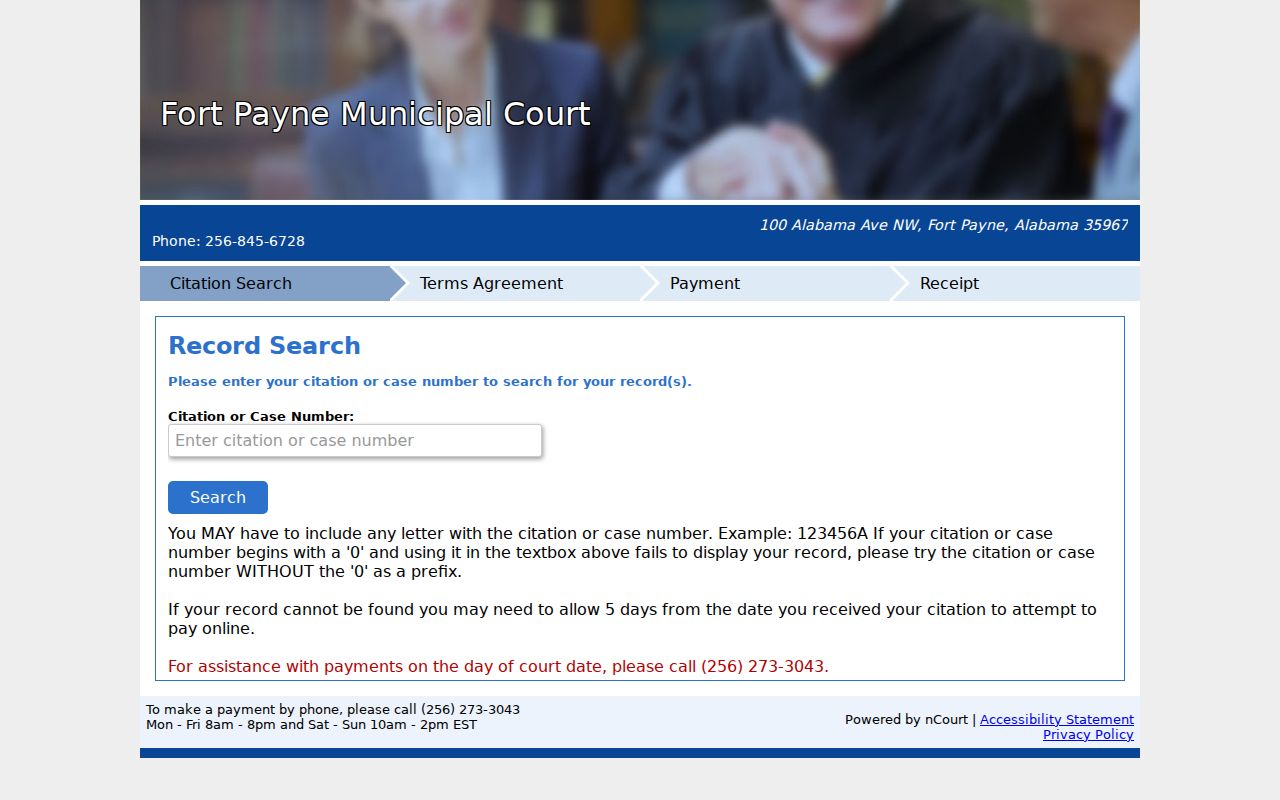
The Fort Payne image belongs on a dockets page because a city citation number can lead to municipal court payment or case status, not to a countywide court file.
Read DeKalb Docket Entries
Several common terms appear in DeKalb court docket work. A case action summary is the event history. A motion is a written request asking the judge for an order. A disposition is the current or final outcome. A subpoena orders a witness or document to appear. A judgment resolves claims or imposes obligations. A trial de novo is a new trial in the appellate court as if the lower proceeding had not occurred.
Disposition language should be read with care. A criminal docket may show charges filed, amended, dismissed, pleaded, tried, sentenced, or appealed. A civil docket may show a default, summary judgment motion, garnishment, execution, appeal, or dismissal. A traffic docket may show payment, trial request, failure to appear, bond forfeiture, license-suspension notice, or warrant-related action. For official use, request a certified copy from the clerk rather than relying on a screen view.
Older DeKalb docket material can require the clerk request route even when a newer case appears online. The records-request form covers computerized searches, archived or microfilmed searches, paper-record examination, copy pages, and certifications. It also says to allow two weeks and warns that payment of fees does not guarantee results.
Note: Docket entries can lag behind court events, and certified copies should come from the record custodian.