
DeKalb Criminal Court Records
DeKalb County criminal court records are kept by the Circuit Clerk for state trial-court cases. Circuit Criminal records include felony case files, grand jury indictment paths, circuit-court dockets, pleas, dispositions, sentencing, appeals, and misdemeanor or ordinance charges that arise from the same incident as a felony. District Criminal records include misdemeanors, preliminary felony proceedings, non-capital felony guilty pleas under concurrent authority, failure-to-appear matters, warrants or capias-related proceedings, and bond-related entries.
The DeKalb Circuit Court page states that Circuit Court is the highest court in the county and where jury trials take place. Under the cited Circuit Court jurisdiction statute, Circuit Court has exclusive original felony jurisdiction and also hears certain misdemeanors tied to felony incidents. District Court has exclusive original trial jurisdiction over many misdemeanors, may hold preliminary hearings in felony prosecutions, and may receive non-capital felony guilty pleas under statutory authority. Fort Payne Municipal Court is separate for city traffic citations, ordinance violations, parking matters, and misdemeanor arrests initiated by Fort Payne Police.
The full criminal case file is different from the narrower charge-focused path described in DeKalb arrest records and court charges. It is also different from jail custody, which belongs with the sheriff and jail roster.
Search DeKalb Criminal Records
For online state trial-court information, use Alacourt ACCESS or Just One Look. Official descriptions say the system covers Alabama civil, domestic, criminal, and traffic trial-court records. The DeKalb Circuit Clerk's page says most trial-court information may be obtained through Just One Look and that fees apply. Certified copies, older files, staff-assisted searches, and records not visible through online access route through the Circuit Clerk's records-request form.
- Start with the court level: Circuit Criminal for felonies or District Criminal for misdemeanors and preliminary felony matters.
- Search Alacourt or Just One Look by defendant name, case number, county, and criminal case category.
- Review the case action summary for charges, arraignment, motions, hearings, plea, disposition, sentence, and appeal entries.
- Use the DeKalb Circuit Clerk request form if a certified disposition, copy, archived search, or paper-record review is needed.
- Use Fort Payne Municipal Court for Fort Payne Police municipal citations or city misdemeanor matters.
The 9th Judicial Circuit prosecutor source was not captured successfully, but the manifest includes the Alabama District Attorneys Association lookup.

That statewide lookup supports the local finding that DeKalb County criminal prosecutions are handled through Alabama's 9th Judicial Circuit District Attorney structure.
DeKalb Criminal Case Stages
A DeKalb County criminal court record grows as the case moves through the trial court. The case may begin with an arrest, complaint, indictment, or other charging step. Then the court record tracks formal events such as arraignment, motions, trial settings, pleas, verdicts, sentencing, cost entries, notices, and appeal filings. The docket may show those events before the full documents are requested or imaged.
Case flow: Charges Filed › Arraignment › Pretrial / Motions › Plea or Trial › Disposition › Sentencing
| Stage | What Happens |
|---|---|
| Charges Filed | The prosecutor, complaint path, or grand jury process identifies the charges that enter the court record. |
| Arraignment | The defendant is formally advised of charges, and plea activity may begin. |
| Pretrial / Motions | Parties file requests, notices, bond issues, discovery disputes, or other matters for the judge. |
| Plea or Trial | The case resolves through a plea, bench or jury trial, dismissal, or other disposition. |
| Sentencing | When there is a conviction, the record may show sentence, fines, costs, probation, restitution, or jail/prison terms. |
What DeKalb Criminal Records Show
Criminal court records can include a mix of party data, charge data, case-management entries, and final outcomes. The public case action summary is often enough to see status, dates, and disposition, but it may not show every document image. Certified copies are requested from the Circuit Clerk when an official disposition or court-stamped copy is needed.
| Field | What It Shows |
|---|---|
| Case Number | The court file number used to request or locate the criminal case. |
| Defendant | The person charged, often with identifying details when public and not redacted. |
| Charges | The offense names, levels, amended charges, dismissed charges, or related charge entries. |
| Plea | The defendant's answer to the charge, such as guilty, not guilty, or other plea activity. |
| Disposition | The current or final outcome, including dismissal, conviction, acquittal, or other resolution. |
| Sentence | Punishment after conviction, including fines, costs, probation, jail, prison, or restitution when shown. |
The manifest includes a Northern District courthouse-location source from the U.S. District Court for the Northern District of Alabama.
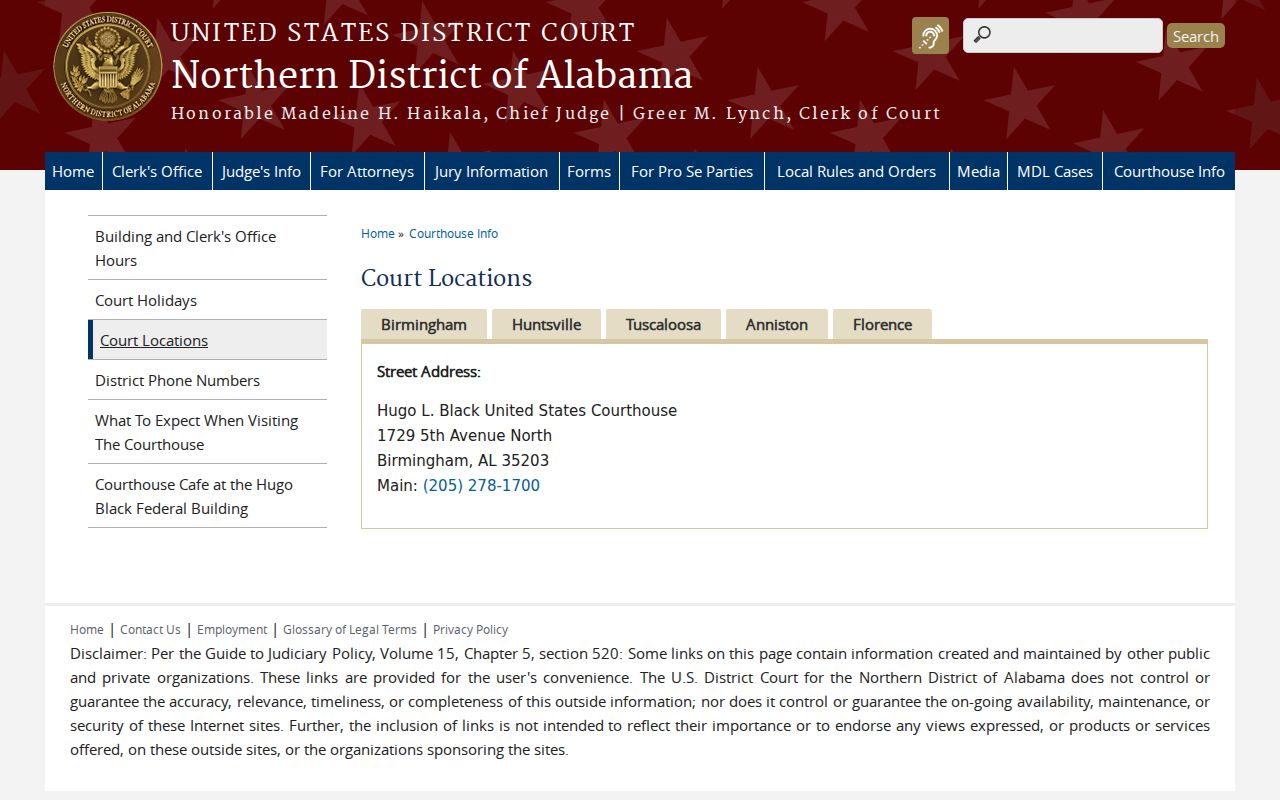
Federal courthouse information is relevant because federal criminal cases are not DeKalb Circuit Clerk records and must be searched through federal systems.
Charges vs. Convictions
A charge is an accusation filed or tracked in the court process. A conviction is a legal outcome after a guilty plea, verdict, or other adjudication. A DeKalb County criminal court record can show charges that were amended, reduced, dismissed, or resolved by acquittal. The disposition field should be read before anyone treats a charge as a conviction.
| Charge | Conviction | |
|---|---|---|
| Stage | Accusation or filed offense | Final outcome after plea or verdict |
| Meaning | The state alleges an offense | The court has a finding or plea of guilt |
| Record Use | Shows case history and prosecution path | Shows the adjudicated criminal result |
DeKalb Dispositions and Sentences
Disposition language tells the reader where the criminal case or charge stands. A docket may show guilty, not guilty, dismissed, amended, nolle prosequi, appealed, sentenced, or closed status. Sentencing entries can include fines, costs, restitution, probation, jail, prison, community supervision, or other conditions. Bond entries and jail custody records may appear near the same case history, but custody should be confirmed with the jail if the person is currently booked.
Federal records should be separated from state criminal court records. The manifest includes the Northern District of Alabama federal court.
The Northern District source reinforces that federal criminal records use federal court systems and PACER rather than the DeKalb Circuit Clerk.
Sealed and Expunged Records
Alabama law treats juvenile records, sealed records, expunged records, adoption files, and sensitive personal information differently from ordinary public criminal court records. Juvenile court information is confidential except where the statute permits access. Expungement is the court process for removing qualifying criminal records from ordinary public access. Eligibility depends on the charge, outcome, timing, prior history, and statutory criteria.
| Sealed | Expunged | |
|---|---|---|
| Visibility | Restricted from ordinary public inspection by law or court order | Removed from ordinary public access through the expungement process |
| Access | May require party status, attorney role, agency authority, or court order | Handled under Alabama's expungement chapter and court order process |
| DeKalb Path | Ask the court holding the file what authority is needed | Identify the exact case, disposition, arresting agency, and court before filing |
Access to Criminal Court Records
Public access starts with Alabama's public-records statutes and the clerk's record-copy process. Ala. Code Section 36-12-40 allows citizens to inspect and copy public records unless another law creates an exception. Ala. Code Section 36-12-41 allows copies upon request and payment of lawful fees. Criminal records are still subject to juvenile confidentiality, sealing, expungement, redaction, and court-order limits.
The Circuit Clerk request form charges $10 per name for computerized search, $25 for archived or microfilmed search, $20 for clerk examination of paper records, $5 for the first 20 copy pages, $0.50 for each additional page, and $5 per certification. It says to allow two weeks, to include a self-addressed stamped envelope, and that personal checks are not accepted.
Important: A casual criminal court lookup is not an FCRA-compliant employment, tenant, credit, or insurance background check.
Restricted DeKalb Criminal Records
Juvenile delinquency records, sealed criminal matters, expunged records, victim information, minor names, certain addresses, Social Security numbers, medical or mental-health details, and other protected data may be absent from public results. An open criminal case may also have filings that are not visible in a public portal. When a record is not visible, that absence does not prove that no case exists. It may mean the record is restricted, held by a different court, older, municipal, federal, or not indexed under the searched name.
For DeKalb Circuit or District criminal records, call the Circuit Clerk at (256) 845-8525 and use the criminal division routing when needed. Kim Hamlin is listed for Circuit Criminal. LaKayla Ramza is listed for District Criminal. For active custody, bond, or booking details, the sheriff's jail line is the better source because a court case file and current jail status are separate records.